
One Hundred Thinking Machines
Video Essays: A Machine to Think With
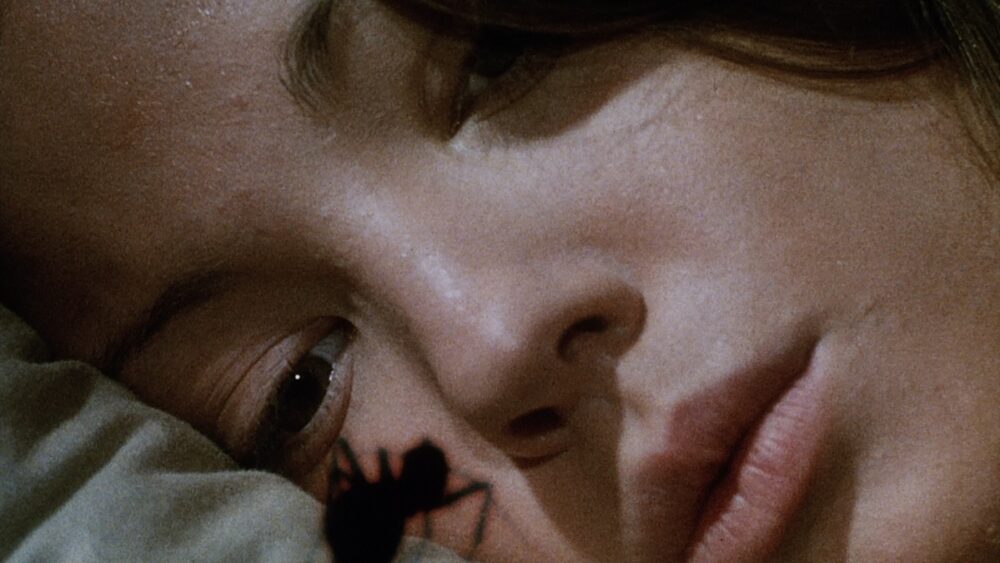
Phase IV (Thinking Machine #70)
Since September 2016, Cristina Álvarez López and Adrian Martin have made a new video-essay for Filmkrant every month in their series The Thinking Machine. On occasion of the hundredth edition, the duo looks back and ahead.
In the Beginning
At first it was just words – plain text. In 2007, Filmkrant editor-in-chief Dana Linssen invited Adrian to write a monthly column titled World Wide Angle (he had initially appeared in Filmkrant back in 2002); the first instalment appeared in October, issue 292. It appeared in Dutch translation in the printed magazine, and in English online. That began as a guide to interesting film-related websites, but quickly became an open musing on themes and issues in the wide world of cinema: festivals, events, criticism, trends.
In its 49th instalment (issue 340, February 2012), the column gained a crucial visual component: a rectangle of images – sometimes illustrative, sometimes cryptic or ‘free associative’. It was less about film culture at large, and more about film analysis – forms and genres, motifs and moments. Cristina, Adrian’s life-partner by this time, did the technical arrangement of every ‘semantic rectangle’ of images.
This lasted until October 2016 (issue 391) – a total of 100 entries for World Wide Angle. Then the revolution came: instead of centring on a text provided by a single author, Cristina and Adrian proposed that a new cycle should begin, based on the audiovisual essay work they had developed together since 2012 (and that Cristina had pioneered by herself back in 2009).
Now the hierarchy between Word and Image (plus Sound), or between Theory and Practice, shifted: the main part of the monthly contribution would be an online video on the Filmkrant website and Vimeo page, with only a short summary statement (and one small image) on page 4 of every printed issue. A word to the wise: when you go the Filmkrant pages for the series, scroll right down to the bottom to find the video, which is the most important part – a decade later, we still have people who manage not to scroll and then ask us, incredulously: “You wrote an essay of just four lines plus one screenshot?”
The Thinking Machine, as we titled our ongoing audiovisual essay project, has now also reached a tally of 100. We intend to keep it going – we are on a rollercoaster that we cannot halt! But first, we wish to stop and look back over what we have done so far.
Our Approach
The idea is simple: for us, it’s an audiovisual (or videographic) notebook. The content always arises from what we happen to be watching (since we watch a film, new or old, almost every day). We will notice something: an intriguing image or sound; a pattern occurring across the breadth of a movie; an unusual gesture performed by an actor. We decide we want to work with it, play with it.
Very often, the spark is ignited across two (or more) films: the uncanny repetition or reworking of a detail or narrative situation; the turn that a genre takes; the hitherto secret key to a beloved auteur’s body of work. See #77 ‘Sectioning Sex’, #52 ‘Open the Doors’ or #19 ‘Series of Dreams Interwoven by Ringing Bells’. We think of it as film criticism in audiovisual form – the kind of film criticism that can never be translated into writing.
Where did that overall title come from? Somewhere in the back of our heads was the famous proposal from 1944 by William Carlos Williams that “a poem is a machine to think with”. More generally and diffusely, we were keen on linking creative processes to the new-fangled ‘machinery’ of digital, technological tools. Most directly and explicitly, we derived the concept (and the precise wording) from the filmmaker-writer extraordinaire, Jean Epstein (1897-1953): his 1946 book The Intelligence of a Machine refers to cinema as the “time thinking machine”. It is no accident that Epstein pops up repeatedly, in various guises, across our first 100 videos for Filmkrant.
We have no overarching theory of the video essay that we either preach or practice. Theories are for tenured academics. No method or approach is ‘off the table’ for us. Each idea demands its own particular form. Sometime we use voice-over narration, and sometimes we don’t; sometimes we use split-screens, superimpositions and other treatments of the image, and sometimes we go for a straight, linear assembly. Sometimes we offer only an introductory on-screen intertitle to announce our intention; sometimes we spread written notes and quotes throughout the piece. We have done pieces with just two clips (#26, ‘Only Free Gestures’); and another with only screenshots (#80 ‘Photo-roman’).
There’s an analytical edge to what we do, and there’s a lyrical edge – but we try to stay close to ‘both sides of the blade’ at once. We are happy to dispense with voice-over or intertitles altogether and let audiovisual montage do all the evident thinking in #9 ‘The Sea Speaks’, #47 ‘Breathless’, #58 ‘As Tears Go By’ and #94 ‘Shot Missing’.
Because we are film critics, we involve ourselves critically with the history of film criticism! In #32 ‘Rearrangement’ we consider an entire review from 1956 by Éric Rohmer of a Western by Anthony Mann, The Last Frontier, and confront his description of a scene with the scene itself. Fredric Jameson’s peculiar obsession with remote-control garage openings in Hitchcock’s Family Plot inspired #87 ‘Garage Door’ – and we found the echo of this motif in Shyamalan’s recent thriller Trap. Among our proudest achievements is #48 ‘Videography 1978’, which tells a tale of historical changes in the reading, writing and translating of film criticism – all mediated by a passing parade of technological devices – via a portion of Adrian’s teenage autobiography.
Auteurs and Beyond
As 2026 rolled in, one could read the caustic American scholar Jane Gaines castigating video essayists en masse: “If the tradition of videographic criticism has privileged auteur style, as it appears to have in the first decade of its currency, it has kept alive the most traditional and even reactionary approach to moving image study.” We make no apology for being attracted to the never-ending task of illuminating auteurs and their expressive styles – why else would be cinephiles, otherwise? Certain beloved directors recur in our series, according to our own obsessions, and the connections we make between films: Akerman, Borowczyk, Bellocchio, Bergman, Hitchcock, Roeg, Varda, Jerry Lewis…
But we also aim, unsystematically, to vary the angle of entry. We looked at the ambiguity of digital special effects in #78 ‘Faux d’artifice’. We investigated the under-recognised role of music cues in #66 ‘Best Film Music Ever’, tracked how one particular song travels between film and television in #46 ‘This Is the Day (Chained Melody)’, and conjured what Zabriskie Point might have looked and sounded like if Antonioni had stuck to hiring The Band instead of Pink Floyd in #69 ‘Great Divide’.
56We began from a philosophical rumination by Giorgio Agamben on pandemic despair for #49 ‘The Burning House’. We have taken excursions into TV-land for Girls (#35 ‘All Inside’), Ripley (#82 ‘Teaching the Audience’), The OA (#30 ‘Dumb City’), Steve McQueen’s Lovers Rock (#45 ‘Roll’n’Rock’) and the Eurovision Song Contest (#81 ’21st Century Mise en scène’). We re-edited an unknown Z-movie to find its inadvertently poetic core in #14 ‘Moon, Waterfall, Tree, Stream’.
We have repeatedly returned to what Luc Moullet calls a politique des acteurs by bringing out what is given to a film by the performance styles of Robert Mitchum (#29 ‘Sigh’), Gloria Grahame (#43 ‘Sex Approaches’), James Stewart (#79 ‘James Stewart Approaches’), Barbara Stanwyck (she scores twice, in #13 ‘Between Two Plot Points’ and #65 ‘Porch Song’), Cary Grant (#85 ‘Your Body is No Longer Your Own’), Tilda Swinton (#93 ‘Longing’), and Leslie Cheung (#37 ‘phantom’) – and then asked, in relation to the experimental cinema of Rouzbeh Rashidi, ‘Do Actors Exist?’ (#59).
Sometimes, the identity of the director – even when we admiringly use their films – is not the central thing at stake. An uncannily shared motif can take the main stage, such as the stains formed by water or ink that announce malign destiny in Don’t Look Now and Dekalog 1 (#64 ‘Inkblot’). Or the strangely sublime images of apocalypse that unite Phase IV and Days of Heaven (#70 ‘Tree of Ants’). Or the delirium and loss of identity that structure both Suddenly, Last Summer and The Legend of Lylah Clare (#16 ‘Up!’).
Acclaim
There has been some acclaim for our labours in Filmkrant. An installation commissioned for the Oviedo Fine Arts Gallery in Spain (2022) contained versions of five Thinking Machine pieces. The annual Sight and Sound poll of ‘best video essays’ since 2017 has blessed 33 out of the 100!
But we are still waiting for Amsterdam’s Eye Filmmuseum to come calling. We do, after all, contribute monthly to the vibrant film culture of the Netherlands!