I.D.
An Elusive but Revelatory Moment
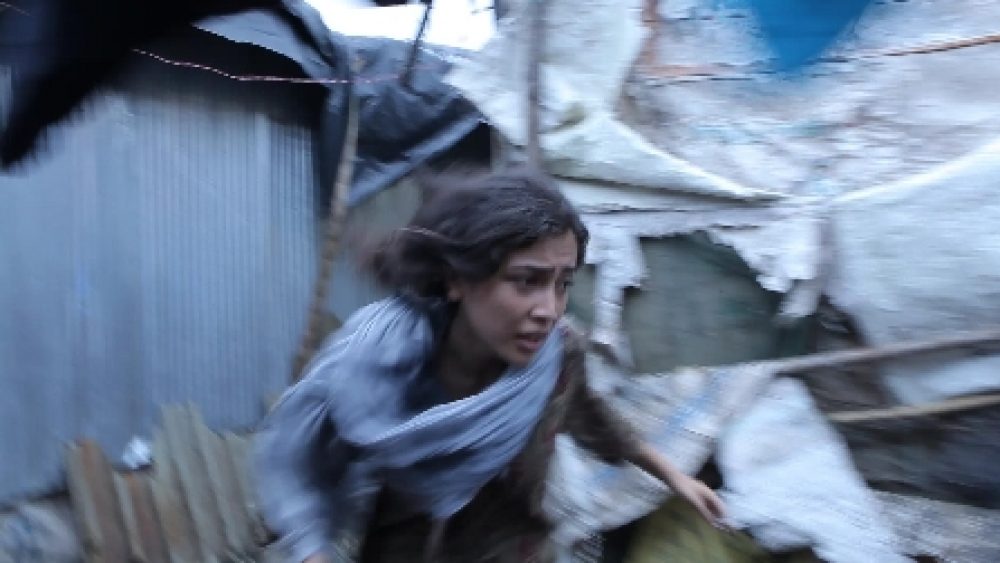
Sam Roggen checks in from Antwerp to report on I.D., a film whose expressively staged compositions inventively expand the visual field beyond the borders of the visible frame.
The defining moment in Kamal Karamattathil Muhammed’s I.D. takes place in the aftermath of a kinetically visualised party in a Mumbai appartment. The film’s main character Charu (Geetanjali Thapa), a young graduate of apparently prosperous background, suddenly becomes aware of the indistinct troubles she has got herself into by attempting to trace the relatives of a painter who collapsed in her apartment earlier that day. Kamal envisions the preceding scenes, including Charu’s tumultuous efforts to get the unconscious man to a hospital, in a frenetically edited amalgam of baroque angles, superficial blue filters and blunt sound design.
He then offers a welcome refuge from this somewhat unbalanced genre exercise when Charu, having thrown out the last quarrelling party guests, remains with her elderly neighbour Aunty. While she fruitlessly tries to contact the painter’s relatives, the film turns away from its pulsating rhythm for the first time, providing room for a moment of intense contemplation. We perceive a pondering Charu in medium close-up, flanked on one side by the immobile Aunty, and on the other by a window revealing the chaotic traffic of nightly Mumbai. In the next shot, cinematographer Madhu Neelakandan’s telephoto lens captures a big close-up of her, now accompanied only by the shallow headlights in the distance, generating an abstract painterly flatness reminiscent of Michael Mann’s nocturnal cityscapes. When she hangs up the phone in the following shot, the blurry traffic pictorially merges with the low-key reflection of her face in the window-glass.
This elusive (but nevertheless revelatory) moment strikingly echoes the poetics of Edward Yang. In Yi yi (2000) he repeatedly invites us to examine characters in direct relation to their environment, the disorderly metropolis Taipei. In order to do so, Yang employs his trademark mise-en-scène of static long takes and panoramic compositions, granting us time and space to scan the whole frame meticulously. The hasty and impersonal Taiwanese capital became a crucial element of Yang’s overall aesthetics, often reflecting, if not contrasting the troubled minds of his protagonists. When Min-Min (Elaine Jin) finds herself on the verge of a nervous breakdown, Yang elegantly marks a sharp contrast between her intense despair and the impersonal, impenetrable city surrounding her. Yang stages her, absorbed in thought, in front of a window, in which her reflection merges with the busy streets of Taipei. He thus suggests that precisely this environment suffocates Min-Min, a suggestion further strengthened by a subsequent scene showing her leaving for a retreat in a Buddhist temple in the woods.
Kamal applies a similar visual strategy to imply tension between psyche and environment. He combines two disharmonic images within the boundaries of the static composition, with reflecting surfaces generating an expressive tableau. He thereby obscures the frame, but at the same time creates a visual overlap with an off-screen reality (just as in the case of Yi yi, a disturbed female character). The resulting ambiguous composition offers an intra-frame variation of the dialectic montage cells; the combination of two images with a radically opposing tone produces above all a pictorial synthesis.
The allegorical parallel with Yi yi becomes all the more relevant when, a few scenes later, Charu has a job interview and her potential employer notices that she looks as if she prefers the more relaxed life style of her former home towns Sikkim and Calcutta, instead of the hectic existence in Mumbai. At the end of their conversation, her cell phone (the film’s leitmotif) rings, eliciting an insert shot of this token of her hectic life, again subtly accompanied by her own reflection in the metal tabletop. With these expressively staged compositions, Kamal inventively expands the optical universe. In spite of his apparently dense mise-en-scène, in these moments, the visual field stretches out beyond the borders of the visible frame. This attention for what takes place off-screen visualises the Bazinian idea of limitlessness, and the cinema as an infinite locus dramaticus, denying all frontiers to the action. The screen is indeed not a picture frame but a mask, allowing only a part of reality to be seen. It requires a cinephile spectatorial posture to perceive as much of the captured reality as possible.
Sam Roggen is a teaching and research assistant and PhD student in Film Studies and Visual Culture at the University of Antwerp. In his PhD, he examines transformed manifestations of cinephilia. Before joining the Visual Studies and Media Culture research group in October 2012, he worked for the Flanders International Film Festival Ghent, the Flemish Service for Film Culture, Cinema Zuid (Antwerp) and Docville International Documentary Film Festival. He is the co-founder of and a regular contributor to the cinephile blog Photogénie (www.photogenie.be).