Towers & Comets (Torres & cometas)
Quirky Travelogue
Diego Lerer checks in from Buenos Aires to report on Torres & cometas, in which past and present of the Portuguese city of Guimaraes are mixed together on the long and winding road of history.
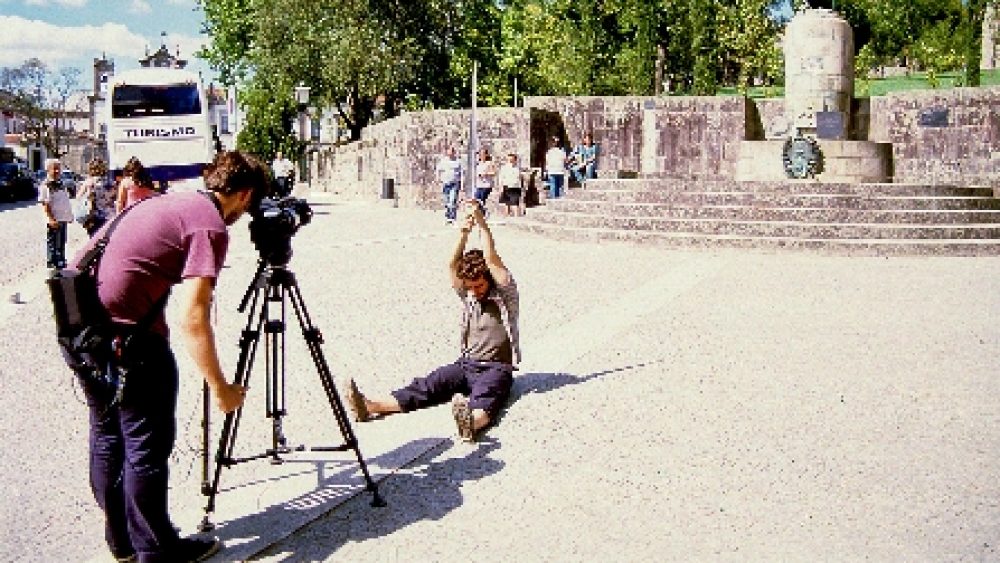
The city of Guimaraes, ’the birthplace of Portugal’ with a history of more than ten centuries, was the backdrop for a collection of feature and short films celebrating its selection as European Capital of Culture in 2012, including works from filmmakers such as Pedro Costa, Victor Erice, Aki Kaurismäki and Manoel de Oliveira. In Torres & cometas, the director of It’s the Earth, Not the Moon, Gonçalo Tocha, moves around the ancient city with his sound engineer, Didio Pestania, trying to capture the ways the past morphs into the present and how the long and mythic history of the place mixes with the daily realities of a country in deep crisis.
Organized as a quirky and strange travelogue that includes a series of conversations by the filmmakers and a few peculiar characters, visits to historical monuments, sites and ceremonies (part of the film was shot during the city’s anniversary celebrations), Torres & cometas starts with a series of photographs that show the changes of Guimaraes’ main plaza through the last centuries and goes on to include, among other things, a visit to "the most beautiful mountain of Portugal", a debate about the only tower that survived from the nine originally built to protect the city and a concert by a very upbeat band at a music festival.
What distinguishes the film are the clashes and observations the filmmakers make and find along the way. When they speak about a monument that "looks the other way", when two characters try to explain the peculiarities of a basilica that has one tower instead of the two it should have had ("We are going to build the other one… someday", they say), or when an old lady goes to a church and ‘steals’ an interview the filmmakers are doing, Torres & cometas has the same spirit of discovery their earlier film had, making a living thing out of old photographs, diaries and history books, but not necessarily in the sense of presenting a list of contradictions. In Tocha’s films, past and present, people and places, are mixed together in a twisted path, the long and winding road of history.
Diego Lerer