
Cinema Under Fire: Australia
From the outback to the backyard and beyond
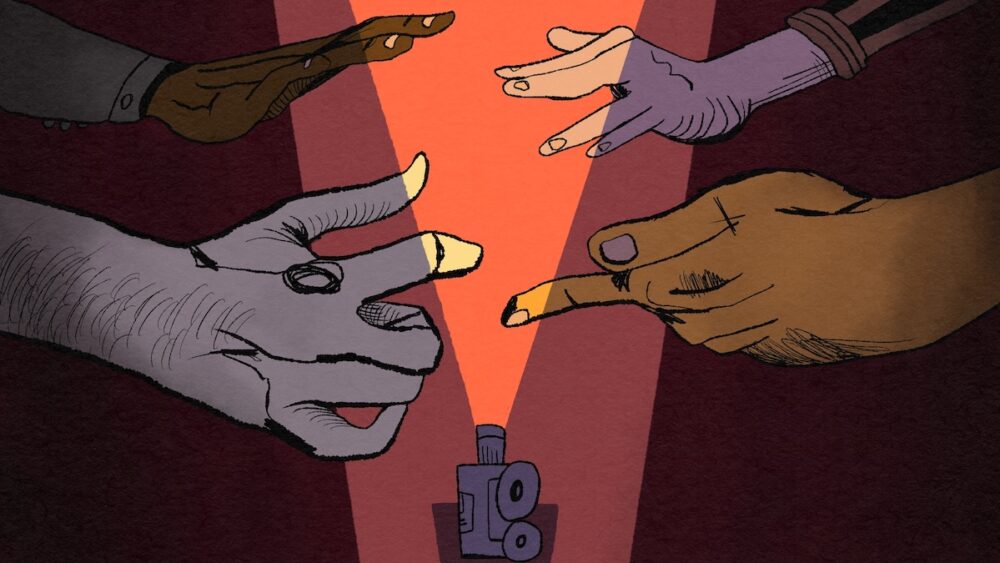
Illustratie (uitsnede): Boris Lyppens
What forces are threatening filmmakers’ freedoms? In a series of contributions from international film critics, Filmkrant reports on the political and economical forces at work on national film production and culture. This month: Australia, where Australian Gothic shows a continuing struggle with the myth of the ‘peacuful settler’.
Amid Melbourne’s COVID-19 lockdowns, the longest and most punitive in the world, I pitched a piece to a local literary magazine on the cult Queensland film All My Friends Are Leaving Brisbane (Louise Alston, 2007). The independent film follows a familiar path for Australian creatives, tracing the quiet humiliation of leaving the muddy waters of a conservative “country town” for the apparent liberalism of neighbouring creative capitals. I wanted to reframe the film’s unpopular embrace of cultural cringe – a term coined by Melbourne theorist A.A. Phillips in the 1950s to describe the belief that Australian culture is second-rate – as a quiet rebuttal to our state-funded film model, which sustains a national cinema resigned to its own cheerful mediocrity.
The editor wanted me to drop the film and lean into this industry critique instead. In that climate of a collapsed Overton window, and as a budding writer with so few words to make my case, the suggestion felt like professional suicide, almost like being told to light a match in a drought, so I let the pitch die. Five years on, my caution proved justified when fellow critic Digby Houghton took a stab at a similar observation and saw his entire body of work pulled by an “independent” editor inflamed by his criticism.
Australia’s cultural output has long existed in this split neurosis. Deleuze and Guattari might call it schizophrenic, where desire is unbound yet endlessly re-coded, rebellion recast as the very thing it resists. Jameson would see it as postmodern pathology, a logic that flattens history into style, circling meaning until only its echo endures. The Australian film industry runs on these closed circuits, an extractor fan exhausting itself between the steam of nationalism and globalism, irony and sincerity, ambition and restraint. Yet what this cycle has yielded, almost by accident, is the only truly enduring cinematic language we have: the Australian Gothic, its survival by mutation owing to its colonial form, which doesn’t deny contradiction but certainly knows how to wield it.
Australian Gothic isn’t a genre so much as a mood, a kind of psychic geography born of mid-twentieth-century colonial art and literature, shaped by displacement and denial. As Jacobs and Gelder argue in Uncanny Australia: Sacredness and Identity in a Postcolonial Nation (1998), the settler imagination is haunted by the land’s refusal to be domesticated, its repressed sacredness returning to unsettle the nation’s sense of self. Finding its fullest expression on film in the 70s, Peter Weir’s The Cars That Ate Paris (1974) imagines a dying town that survives by staging car crashes, its people feeding on wreckage as ritual. Following suit, Weir’s Picnic at Hanging Rock (1975) descends into reverie, with schoolgirls swallowed by stone and sunlight, as time folds back on itself. Together they sedimented the style, making the landscape sentient and spectral, drawing the nation’s bruised and buried psyche to the surface. When Prime Minister Gough Whitlam’s reformist Labor government revived national film funding in the same decade, that uncanny imagination became a national export – Australia’s existential ear worm refashioned as soft power and its ghosts recruited into the project of cultural modernity.
By the late 1980s, that outward projection of a fractured national identity turned inward. The optimism of the Whitlam years hardened into the pragmatic realism of the Bob Hawke/Paul Keating era. Film policy followed in step, equating creativity with productivity. After Parliament blamed the 10BA tax break for a glut of so-called low-quality films, it replaced private risk with state control, manufacturing the shift as a rescue mission for the industry. What followed was less a national voice than a stage-managed mask, with Crocodile Dundee (Peter Faiman, 1986) as emblem for exportable Australianness – laconic, masculine, mythic and designed for overseas consumption – setting a standard where selfhood slipped into vaudevillian pantomime.
The 1990s saw the Australian Gothic’s bifurcated logic of the settler persona shifted from outback to backyard. Muriel’s Wedding (P.J. Hogan, 1994) turns the suburban search for reinvention into a pastel nightmare, its heroine a delusional romantic whose humiliation becomes a communal spectacle. The Castle (Rob Sitch, 1997) inverts the pattern as belonging hardens into faith and the suburban home is defended with comic zeal. The two films centre bumbling, good-natured innocents – too earnest to see the system they serve, too human to condemn. Their optimism feels both tragic and tender, reflecting a nation still pretending not to know itself. What once haunted the horizon now lingers in the home, its tension eased through self-deprecating laughter.
And when Australia’s directorial ambition reached for world-stage acclaim, legitimacy was sought through inheritance. Romeo + Juliet (Baz Luhrmann, 1996) borrowed Shakespeare’s gravitas to signal the nation’s creative maturity, proof that the colony could handle the canon. That fixation lingered through Macbeth (Geoffrey Wright, 2006) which transposed Elizabethan paranoia onto Melbourne’s underworld, into Measure for Measure (Paul Ireland, 2019), a post-HBO-styled morality play about Islamophobia, addiction and violence. Its depiction of a Muslim family’s clash with white suburbia gestured toward multicultural complexity but crash-landed closer to tokenism.
When the nation tired of borrowing from empire, it began to curate difference instead. What once passed for cultural legitimacy through imitation shifted to moral legitimacy through inclusion. Following the 1992 Mabo decision, which overturned terra nullius and recognised Indigenous land rights, Australian cinema entered what Collins and Davis called the era of “reconciliation cinema” (Australian Cinema After Mabo, 2004). Films like Rabbit-Proof Fence (Phillip Noyce, 2002), in which three Aboriginal girls flee state capture, and The Tracker (Rolf de Heer, 2002), following an Indigenous guide leading white officers in pursuit of another Aboriginal man, reimagined the nation through remorse and repair, yet their moral clarity resolved into the comfort of white absolution.
That same reflex carried into representations of migrant life. The Heartbreak Kid (Michael Jenkins, 1993) turned cross-cultural romance into a civics lesson, its humour resting on the migrant’s willingness to assimilate. Looking for Alibrandi (Kate Woods, 2000) translated class and cultural tension into personal reconciliation, ending with gratitude instead of critique. Ali’s Wedding (Jeffery Walker, 2017) replayed the same arc through Muslim identity – the dutiful son torn between love and obligation, his rebellion contained by familial loyalty and moral charm. Amazon Prime’s Five Blind Dates (Shawn Seet, 2024) Americanises this benevolent settler psyche for the streaming era, where cultural markers serve as lifestyle décor and diversity functions as branding. Having caricaturised difference and reframed remorse, the nation continues to make migrant identity another mirror for its colonial self-image.
Ghassan Hage’s concept of the White Nation fantasy (White Nation: Fantasies of White Supremacy in a Multicultural Society, 1998) helps explain this turn-of-the-century tightening of Australia’s moral frame – the belief that social order depends on those who police the boundaries of the “mainstream.” Under John Howard’s conservative Liberal government, self-reliance became creed, austerity a virtue, and whiteness a civic duty disguised as care. When Screen Australia replaced its predecessor agencies in 2008, it inherited the same fantasy. Phrases like “distinctively Australian” and “commercially viable” fenced artistic risk within the bounds of taste, turning creativity into cultural compliance. Even Prime Minister Kevin Rudd’s apology to the Stolen Generations of the same year functioned more as symbolic repair than lasting structural change.
Against that backdrop, Australian Gothic moved from the outback to the backyard , then to the interior. The homemaker humour and nervous laughter of the 1990s gave way to something harsher – a psychological thirst for order, confession and self-punishment. And from it emerged the angry Anglo everyman.
Chopper (Andrew Dominik, 2000) marked this turn, its criminal bravado reframed as moral theatre where violence becomes both confession and performance. Snowtown (Justin Kurzel, 2011) pushed that impulse inward, turning banality into horror through the ritual precision of abuse, while Nitram (Justin Kurzel, 2021) completed the cycle, aestheticising alienation itself so the killer appears not as monster but as symptom. This figurehead of the Australian Gothic progressed to the haunted maternal figure and the anxious adolescent witness, where everyday objects and relationships become conduits of dread. The Babadook (Jennifer Kent, 2014) and Run Rabbit Run (Daina Reid, 2023) transform maternal fear and obsessive vigilance into moral spectacle, while the Philippou brothers’ Talk to Me (2022) and Bring Her Back (2025) escalate adolescent curiosity and domestic entanglement into A24-style prestige horror, marking the ultimate epoch of Australian Gothic’s Protestant realism. What was once repressed and replaced is now ritualised – our split neurosis now on high-definition display, still unable to offer its origins release.
Throughout the years, Australia’s government-regulated film industry has engineered precarity and fused it with affective capital, turning national trauma into its primary growth sector. Beneath its polished rhetoric of recovery lies an exhausted public, resigned to the knowledge that belief itself is now professional duty. Ask anyone in or around the industry and you’ll hear it, though rarely on record – for fear of repercussion, and rightly so: Australian films, especially to Australian audiences, mostly suck. “Funding bodies are structured so they rarely support emerging voices pushing against the status quo”, a head programmer at a major national film festival told me. “Our institutions are completely divorced from public taste”, a cultural critic from a national legacy media outlet confessed.
Why? Because they perform a version of Australian reality that either doesn’t exist or exists only to reassure itself. No doubt the government’s performance of optimism will endure – boasting vitality, ministers citing success stories, panels rehearsing progress. No one wants to name the rot unless it’s “profitable”, ideologically or otherwise, which is why the nation’s most inventive work is made independently, on shoestring budgets. Grape Steak (André Shannon & Jack Atherton, 2023), A Grand Mockery (Adam C. Briggs & Sam Dixon, 2024) and Salt Along the Tongue (Parish Malfitano, 2024) are finding traction overseas while flying beneath the radar of our cultural gatekeepers. This new wave metabolises what I’d pre-emptively call a new Australian Gothic – one that turns scarcity into texture, fatigue into tone and fragmentation into form. A cinema honest and resilient enough to thrive inside the psychic contradiction of colony.
Olivia J. Bennett is an Australian writer and critic. Her work has appeared in Variety, DAZED, Art+Australia and elsewhere. She is an alum of the Locarno Film Festival Critics Academy and Melbourne International Film Festival Critics Campus.