Cinema Under Fire: Hungary
Muffling critical voices
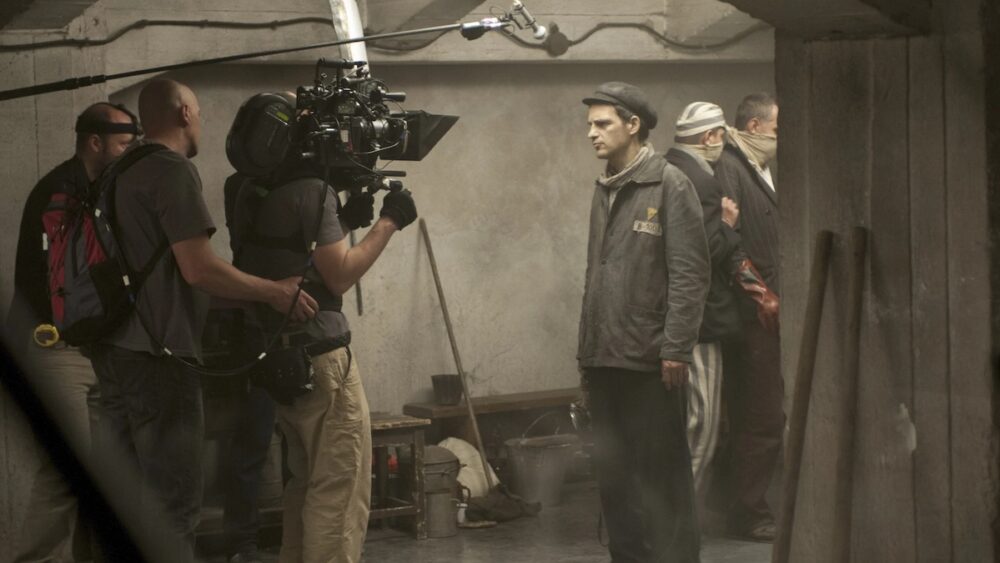
Op de set van Son of Saul
What forces are threatening filmmakers’ freedoms? In a series of contributions from international film critics, Filmkrant reports on the political and economical forces at work on national film production and culture. This month: Hungary, the country of Enyedi and Mundruczó.
Between 2019 and 2020, the Hungarian film industry was shaken by two major events: first, the death of Andy Vajna, in January 2019; and second, governmental imposition on the national film school in the Summer of 2020.
Andy Vajna, a film producer with a Hollywood career, was the appointed ‘government commissioner’ for the National Film Institute (NFI). The NFI was founded in 2011 (one year after the start of the first of five consecutive mandates led by the government led by Orbán and his party, FIDESZ) through a merger of the pre-existing Hungarian National Film Fund (MNFA), the Film Archive and other organisations.
As is the case in several European countries, the Hungarian film industry is largely supported through state subsidies, and the NFI assigns specific grants for the development, production and distribution of films. Deliberations are currently available online dating back until 2014, with some omissions: no justification is provided for rejected projects (which also leave blank the names of the filmmakers and companies that received the rejection), and some documents are missing.
The fact that Vajna lead the selection committee of the fund has been the subject of several controversies. The producer, by 2015, owned one of the country’s largest private television channels (the NFI also supports tv production), and multiple decisions have been perceived as problematic.
A specific case in December 2014 (Deliberation 039) saw the assignment of the then-record amount of 790 million Hungarian forint (roughly 2.6 million euro) to Home Guards (Veszettek, 2015), produced by Gábor Kalomista and co-written by a member of the selecting committee, Réka Divinyi. The same deliberation round assigned less than half the sum to Son of Saul (Saul fia, 2015), which went on to win an Oscar after a triumph in Cannes, while Home Guards opened to a measly 3.694 tickets sold. Kalomista has later produced the 2021 film The Cost of Deception (Elk*rtuk), a political thriller widely criticised for depicting opposition politicians negatively which, officially, did not receive state funds.
It is widely considered today that Vajna – perhaps to avoid full accusations of being political in its deliberations – still somewhat supported critical and independent voices. Starting from 2015, the NFI established the Inkubátor Program, with the purpose of aiding financially filmmakers to develop, produce and release their debut feature. Acceptance in the program seemingly guaranteed a project’s completion and subsequent release. There’s a wide perception that the films produced through the program featured sharper political criticisms.
The second earthquake that shook Hungarian cinema occurred in the summer of 2020: the National Film and Theatre University (SZFE)’s rectorate underwent a series of changes that were interpreted as a governmental imposition, leading to layoffs of almost the entire teaching body and protests by the students. The Free SZFE movement, supported by most of the more critical and prominent Hungarian filmmakers, like Béla Tarr, Ildikó Enyedi, Kornél Mundruczó, quickly organised an independent educational system providing an unofficial alternative curriculum.
It has been the impression that, following the protests, the NFI (now under the supervision of Csaba Káel) would more regularly reject screenplays linked to professionals who have expressed political positions critical of the government. It definitely was not motivated by a lack of funds: the historical film Now or Never! (Most vagy Soha!) by Balázs Lóth, highly criticised for its historical inaccuracies and alledged revisionism, received an initial budget of 4.5 billion forint (adjusted for inflation, roughly 15 million euro).
In an industry panel at the Les Arcs Film Festival 2023 dedicated to the production of Explanation for Everything by Gábor Reisz, producer Júlia Berkes cited the fact that Reisz – whose previous films were partly funded by the NFI despite containing some political elements – had his application rejected following the SZFE protests, prompting him to write this film. Explanation for Everything was entirely independently produced, with a final budget (after post-production) of roughly 137.000 euro, employing several debutant professionals and utilizing DIY equipment such as wheelchair-dollies. Part of the initial production costs has been obtained through a budget that production company Proton Cinema obtained through service gigs for foreign productions.
The Inkubátor Program also underwent significant changes: the regulations were modified for the 2021-22 edition, introducing, among other changes, the possibility for the committee to reassess the destination of the project at any stage of its development (e.g.: instead of a theatrical release, a streaming or television release). According to a March 2023 Telex article, several of the projects that were in the script development phase in the previous year were shut down. The deliberation document of December 2022, containing the decisions regarding all participants of that year’s program, bears the exact same ambiguous phrase for all selected projects: “The committee accepts the final version of the screenplay, closes the supporting process.” No distinction is made between projects that see the script process closed and the start of the next phase, and those that received via email a rejection as far as further development goes.
With the state fund seemingly intent on refusing financial support to critical filmmakers, they have sought alternative routes. Zsófia Szilágyi, whose film One Day (Egy nap, 2018) was made through Inkubátor, applied for Biennale College for her second film, Szeptember 2. (2024). At a press conference during the Venice Film Festival, she claimed that she deliberately chose to avoid the NFI application process, voicing a sentiment widespread among more independent film professionals. 2024 also saw the release of Lesson Learned (Fekete pont; Bálint Szimler) at the Locarno Film Festival, which lists around twenty independent producers in its credits, lead by Gábor Osváth.
Except for a specific situation in which Ádám Tősér, filmmaker of the NFI funded film Blokád (2024) physically assaulted independent film critic Géza Csákvári because of a review, independent voices mostly fear financial repercussions. Interviewed in Venice at the premiere of Explanation for Everything, Reisz and Berkes implied that their main concern was that financial and fiscal elements would be instrumentalised by institutions.
Szimler has since served as the creative director of the newly and independently formed Budapest International Film Festival (BIFF), which, starting from 2025, also started providing an independent film fund for the development of projects outside the state-funded channels.
The new tendencies in the rather small Hungarian festival circuit, besides the rather successful first two editions of BIFF, are encouraging also due to the rebirth of a historic event, the Magyar Filmszemle (Hungarian Film Week), a competitive festival dedicated to Hungarian cinema which served a pivotal role in the yearly recognition of the best national production. The original Magyar Filmszemle ran from 1989 to 2012, and replaced the previous government-subsided Jatékszemle (‘feature review’) which had a similar scope. Reformed in 2025 under the guide of the independent Hungarian Film Society (MAFSZ), it received the endorsement of the Budapest city council (which has an opposition leadership under Gergely Karácsony) and is currently at its second year.
The last few years have seen the rise of an independent community that, amidst financial difficulties, manages to support free voices in Hungary. While the future remains uncertain, the April elections will likely be determining.